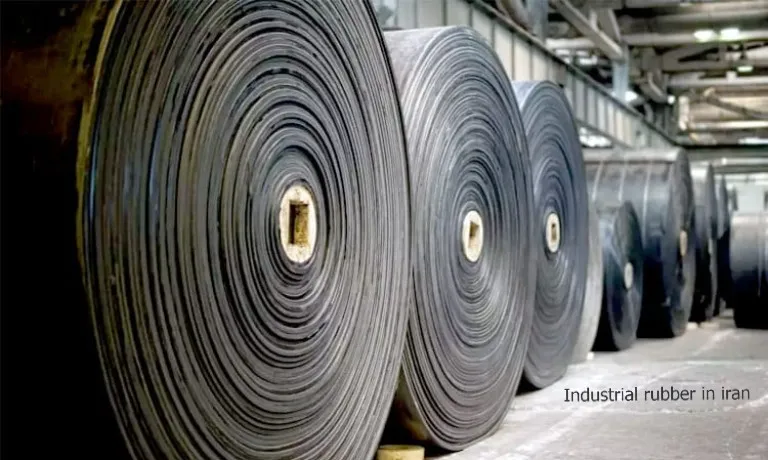
Industrial rubber in iran
Industrial rubber in Iran
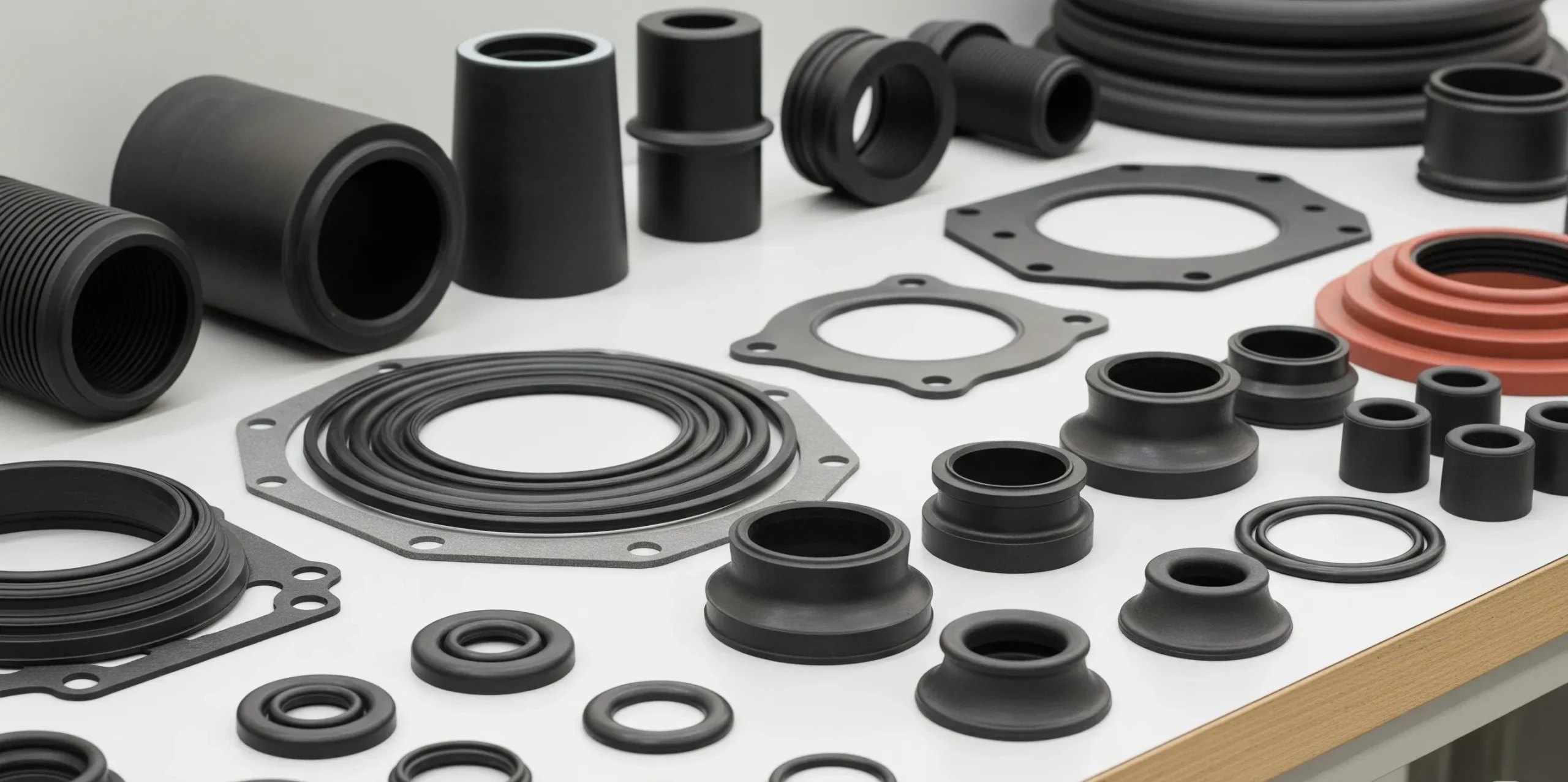
The Story Behind Industrial Rubber Manufacturing in Iran
Rubber has been part of industrial life in Iran for close to a century, moving from small tire-repair workshops in Tehran’s Bazaar district to a network of dedicated factories that now supply gaskets, seals, hoses, conveyor belts, and molded components to oil and gas, automotive, construction, and water-management industries. The early rubber trade in the country largely revolved around tire retreading and simple molded goods, using imported natural rubber and basic vulcanization equipment. As domestic demand grew through the second half of the twentieth century, driven mainly by the expansion of the automotive sector and the National Iranian Oil Company’s infrastructure projects, local manufacturers began investing in compounding know-how, mixing mills, and press-curing lines rather than relying solely on imported finished parts.
Today, Industrial Rubber in Iran covers a much broader spectrum than the tire-repair origins of the trade. It includes synthetic rubber compounding, custom molding, extrusion of profiles and hoses, and increasingly, polymer-based elastomers such as polyurethane that were rarely produced domestically a generation ago. Understanding how this industry works — from raw material selection through to the finished, tested component — is essential for engineers, procurement teams, and buyers who need rubber parts that perform reliably under heat, pressure, chemical exposure, or constant mechanical stress. The sections below walk through the production process, the material choices available, and the practical considerations that separate a part that lasts for years from one that fails prematurely.
What Counts as Industrial Rubber and Why the Category Matters
“Industrial rubber” is a broad term that covers any elastomeric material engineered for functional, load-bearing, or sealing roles in machinery and infrastructure, as distinct from rubber used in consumer goods like footwear or toys. The category includes both natural rubber (NR), harvested from latex, and a family of synthetic rubbers developed to solve specific performance problems that natural rubber cannot handle on its own — resistance to oil, ozone, extreme temperature, or abrasion.
For a buyer or design engineer, the distinction matters because no single rubber compound is “the best” in every situation. A gasket sitting inside a diesel engine has almost nothing in common, functionally, with a conveyor belt cover exposed to sunlight and abrasive minerals, or a hydraulic seal working against high-pressure oil. Choosing the right base polymer is the first and most consequential decision in any rubber part specification, and it is a decision that has to be made before compounding, molding, or curing even begins.
The Main Families of Industrial Rubber
| Rubber Type | Common Abbreviation | Key Strength | Typical Weakness | Typical Use |
|---|---|---|---|---|
| Natural Rubber | NR | High elasticity, tear strength | Poor oil and ozone resistance | Shock mounts, general seals |
| Styrene-Butadiene | SBR | Good abrasion resistance, low cost | Poor oil resistance | Tire components, general molded goods |
| Nitrile | NBR | Excellent oil and fuel resistance | Poor weathering, ozone cracking | Fuel hoses, oil seals, O-rings |
| EPDM | EPDM | Outstanding weather and ozone resistance | Poor oil resistance | Roofing membranes, outdoor seals, radiator hoses |
| Silicone | VMQ | Wide temperature range, food-safe grades | Low tear strength, high cost | Food and medical seals, high-temperature gaskets |
| Neoprene | CR | Balanced oil, weather, and flame resistance | Moderate cost, average abrasion resistance | Cable jacketing, marine fenders |
| Polyurethane rubber | PU / AU / EU | Exceptional abrasion and load-bearing capacity | Limited heat and hydrolysis resistance | Rollers, wheels, scrapers, lining for abrasive material handling |
Each of these polymers is available in multiple grades, and within Iran’s manufacturing base, the availability of imported versus domestically compounded raw material can affect lead time and cost far more than it affects the final technical performance of the part — a distinction that is often overlooked by first-time buyers who assume “local” automatically means “lower quality.” In practice, a well-controlled domestic mixing line using properly sourced polymer, carbon black, and curing agents can match imported parts on mechanical properties; the differentiator is quality control discipline, not geography.
How Industrial Rubber Is Actually Made: The Production Process Step by Step
Understanding the manufacturing sequence is useful even for buyers who will never set foot in a factory, because each stage introduces variables that affect the final part’s durability, dimensional accuracy, and cost. The process below describes standard practice for rubber compounding and molding as used across the industry, not a proprietary method belonging to any single company.
1. Raw Material Selection and Formulation
Every rubber part begins as a formula, not a piece of material. A compounder starts with the base polymer (natural or synthetic) and adds a package of other ingredients:
- Fillers, most commonly carbon black or precipitated silica, which reinforce the rubber and can make up 20–50% of the total compound weight.
- Plasticizers and process oils, which improve flow during molding and can be adjusted to fine-tune hardness.
- Curing agents, typically sulfur-based systems for general-purpose rubbers, or peroxide systems for compounds that need higher heat resistance.
- Accelerators and activators, which control how fast and how completely the vulcanization reaction happens.
- Antioxidants and antiozonants, which slow down the degradation caused by oxygen, UV light, and atmospheric ozone.
- Pigments, when a color other than the standard black is required.
The ratio of each ingredient is not arbitrary. A formulation intended for a food-grade conveyor belt will avoid certain plasticizers entirely, while a formulation for an oil-field seal will be built around oil-resistant base polymers like NBR or fluoroelastomers rather than natural rubber. This is the stage where most of a part’s eventual performance — or failure — is actually determined; molding and curing later in the process cannot compensate for a poorly designed formula.
2. Mixing
The raw polymer and additives are combined in an internal mixer (commonly a Banbury-type mixer) or on an open two-roll mill. Mixing generates significant friction heat, and controlling that heat is one of the more technically demanding parts of the process — overheating during mixing can cause premature (scorch) curing, ruining the batch before it ever reaches the mold. Well-run mixing rooms monitor batch temperature closely and follow a defined mixing cycle (polymer first, then fillers, then oils, then curatives added last at lower temperature) to keep the compound stable until it reaches the forming stage.
3. Forming: Extrusion, Calendering, or Molding
Once mixed, the compound is shaped using one of three broad methods, chosen according to the geometry of the finished part:
- Extrusion pushes the rubber compound through a shaped die to create continuous profiles — hoses, seals, weatherstripping, and gaskets with a constant cross-section.
- Calendering passes the compound between heated rollers to produce sheet rubber of controlled thickness, used for belting, lining, and flat gasket stock.
- Molding — compression, transfer, or injection molding — shapes the compound inside a heated mold cavity, used for parts with complex three-dimensional geometry like custom seals, bushings, and mounts. Injection molding offers the tightest dimensional tolerances and is generally preferred for high-volume, precision components; compression molding remains common for lower-volume runs or very large parts where tooling cost needs to stay low.
4. Vulcanization (Curing)
Vulcanization is the chemical reaction — usually triggered by heat and the curing agents added during mixing — that transforms the soft, pliable compound into a durable, elastic rubber part with the mechanical properties needed for service. Cure time and temperature are specific to each formulation; undercuring leaves a part soft and prone to permanent deformation, while overcuring can make the rubber brittle and reduce its elongation at break. This is typically the stage where a factory’s process control — accurate temperature monitoring, consistent press timing, calibrated curing ovens — has the most direct effect on whether parts from the same formula perform consistently batch after batch.
5. Post-Cure Treatment and Finishing
Some compounds, particularly silicone and certain high-performance grades, benefit from a secondary post-cure bake in an oven to drive off residual by-products of the curing reaction and stabilize the final mechanical properties. After curing, parts move to finishing operations: deflashing (removing the thin excess rubber left at mold parting lines), trimming to length for extruded profiles, and any secondary bonding to metal inserts or other substrates.
6. Quality Inspection and Testing
Before parts leave the factory, they typically go through a combination of dimensional checks and physical property testing. Common tests in industrial rubber quality control include:
- Hardness testing (Shore A or Shore D durometer), to confirm the compound meets its specified stiffness.
- Tensile strength and elongation testing, pulling a sample to failure to check strength and stretch.
- Compression set testing, which measures how well a rubber recovers its shape after being compressed for a set period — critical for gaskets and seals that must maintain sealing force over time.
- Visual and dimensional inspection, checking for surface defects, porosity, and conformance to drawing tolerances.
A factory that documents these results against a defined specification — rather than relying on visual inspection alone — is generally a stronger indicator of manufacturing discipline than the size of its facility or the age of its equipment.
Rubber-to-Metal Bonding for Composite Components
Many industrial rubber parts are not pure rubber at all — they are composite components where rubber is permanently bonded to a metal insert, plate, or shaft. Engine mounts, anti-vibration bushings, shaft seals with a metal casing, and rubber-lined rollers all depend on this bonding step, and a weak bond is one of the more expensive failure modes in industrial rubber manufacturing, since the part typically has to be scrapped entirely rather than repaired.
The bonding process generally follows a defined sequence:
- Surface preparation of the metal component, usually through grit blasting to create a rough, contaminant-free surface profile that the bonding agent can key into.
- Application of a bonding agent system, typically a two-coat process — a primer coat that chemically bonds to the metal substrate, followed by a cover coat formulated to bond with the specific rubber compound being molded onto it.
- Molding the rubber directly onto the prepared metal inside the same heat and pressure cycle used for curing, so the vulcanization reaction and the adhesive bonding reaction happen simultaneously.
- Bond strength testing, most commonly a peel or pull test on sample parts from each production batch, since a bond that looks intact visually can still fail under load if the primer coverage was inconsistent.
For buyers specifying bonded components, it is worth asking directly whether the manufacturer performs batch-level bond testing rather than relying on visual inspection alone, since bonding defects are frequently invisible until the part is already in service and under load.
Domestically Manufactured Versus Imported Industrial Rubber in Iran
Buyers sourcing rubber components inside the country routinely face a choice between parts produced by domestic factories and finished goods imported from established international manufacturers. Neither option is automatically the right answer, and the decision usually comes down to a handful of practical factors rather than a general assumption about quality.
Lead time and logistics tend to favor domestic manufacturing, particularly for custom or non-standard parts, since local factories can typically turn around tooling and small production runs faster than waiting on international shipping, customs clearance, and minimum order quantities that many overseas suppliers require.
Raw material sourcing is where the picture becomes more mixed. Some base polymers and specialty additives used in Iranian rubber compounding are imported, which means domestic manufacturing cost and availability can be affected by international supply conditions even when the finished part is produced locally. Buyers working on time-sensitive projects are generally well served by asking a supplier directly about raw material lead times before committing to a delivery schedule, rather than assuming domestic production removes all supply chain risk.
Technical documentation and traceability have historically been a differentiator in favor of larger, export-oriented international manufacturers, who often maintain more standardized batch testing records as a matter of course for export compliance. This gap has narrowed considerably as domestic manufacturers serving the oil, gas, and petrochemical sectors have adopted more rigorous internal quality systems, often driven by the documentation requirements of large industrial clients. A buyer evaluating either option should ask for the same thing regardless of origin: batch test data, not just a certificate of conformance.
Cost is rarely a simple comparison either, since import costs are affected by currency exchange conditions, shipping, and customs duties in ways that can shift meaningfully between the time a quote is issued and the time an order is actually placed — a dynamic that makes domestic sourcing more predictable for budgeting purposes even when the base unit price looks comparable.
Polyurethane Rubber: A Closer Look at a Growing Category
Among the various elastomer families used in industrial applications inside Iran, polyurethane rubber deserves separate attention because it behaves quite differently from conventional rubbers and is increasingly specified where standard NR or SBR compounds wear out too quickly. Polyurethane elastomers are formed through a different chemistry than sulfur-vulcanized rubbers — they are built from the reaction of polyols and isocyanates rather than from cross-linking a diene-based polymer — and this different chemical backbone is what gives them their distinctive mechanical profile.
The main practical advantage of polyurethane rubber is abrasion resistance combined with high load-bearing capacity. A polyurethane wheel or roller can often outlast an equivalent rubber part by a wide margin in applications involving constant rolling contact, impact, or exposure to abrasive particulate — which is why it has become a common choice for material-handling rollers, scraper blades in mining and cement operations, and industrial wheels for forklifts and conveyor systems. It also offers good resistance to oils, greases, and many industrial solvents, filling a gap between general-purpose rubbers and more expensive fluoroelastomers.
The trade-off is that polyurethane is more sensitive to heat and to continuous exposure to water or high humidity (hydrolysis), which can gradually degrade certain grades if the polymer type is not matched correctly to the operating environment. This is exactly the kind of decision where formulation expertise matters: polyester-based polyurethanes offer better abrasion and oil resistance but weaker hydrolysis resistance, while polyether-based grades trade some abrasion performance for much better resistance to water and microbial attack. Specifying the wrong grade for a wet or humid environment is one of the more common and avoidable causes of premature polyurethane part failure.
Comparing Industrial Rubber Types for Real-World Decisions
Choosing between conventional rubber and polyurethane rubber — or between the various synthetic rubber families — is rarely about which material is objectively “better.” It is almost always about matching material properties to the specific stresses a part will face. The table below summarizes the trade-offs that typically drive this decision in practice.
| Consideration | Conventional Rubber (NR/SBR/NBR/EPDM) | Polyurethane Rubber |
|---|---|---|
| Abrasion resistance | Good to moderate, depending on grade | Generally superior |
| Load-bearing capacity | Moderate | High |
| Oil and chemical resistance | Varies strongly by polymer type | Good, with grade-dependent limits |
| Heat resistance | Varies, generally acceptable up to 100–150°C depending on polymer | Typically more limited, especially under continuous load |
| Water/hydrolysis resistance | Generally stable | Grade-dependent; some types degrade in continuous moisture |
| Typical cost | Lower for general-purpose grades | Higher, reflecting raw material and processing cost |
| Common failure mode | Cracking, hardening, or swelling depending on exposure | Softening or chunking under heat, humidity, or UV over time |
For a procurement engineer working through a specification, the practical takeaway is to define the operating environment first — temperature range, chemical exposure, load, and moisture — before selecting a polymer family. A supplier who asks detailed questions about the application before recommending a compound is generally a better sign than one who quotes a price based on drawing dimensions alone.
Where Industrial Rubber Is Used Across Iranian Industry
The demand for industrial rubber components in Iran is spread across a handful of dominant sectors, each with its own set of technical requirements.
Oil, Gas, and Petrochemical Sector
This sector is one of the largest consumers of custom rubber seals, gaskets, and hoses in the country, given the scale of Iran’s upstream and downstream operations. Components here typically demand resistance to hydrocarbons, high pressure, and in some cases sour service (hydrogen sulfide exposure), which usually rules out general-purpose rubbers in favor of nitrile, hydrogenated nitrile (HNBR), or fluoroelastomer compounds depending on the specific service conditions.
Automotive and Transportation
Rubber bushings, engine mounts, weatherstripping, hoses, and belts remain a large and steady source of demand, supplied both to original equipment lines and to the aftermarket. Since much of this demand is price-sensitive and volume-driven, SBR and NR-based compounds, along with EPDM for weather seals, dominate this segment.
Construction and Infrastructure
Expansion joints, waterproofing membranes, bridge bearings, and pipe gaskets rely heavily on EPDM and natural rubber compounds chosen for their weathering and water resistance. As urban infrastructure projects continue, this segment has grown as a stable, if less headline-grabbing, source of demand for industrial rubber manufacturers.
Mining, Cement, and Material Handling
This is where polyurethane rubber has carved out a particularly strong position. Conveyor rollers, chute liners, screen panels, and scraper blades in mining and cement plants face constant abrasive wear from rock, ore, and clinker, and the superior wear life of polyurethane components — even at a higher upfront cost — frequently makes it the more economical choice over the life of the equipment when downtime and replacement labor are factored in.
Water and Wastewater Management
Gaskets, seals, and diaphragms used in valves, pumps, and treatment equipment need to resist prolonged water exposure without swelling or degrading, a requirement that typically favors EPDM and, for potable water applications, compounds certified against relevant drinking-water safety standards.
A Practical Framework for Selecting an Industrial Rubber Supplier
For buyers who are less familiar with the technical side of rubber manufacturing, the decision often comes down to evaluating a supplier rather than evaluating a material directly. A few practical checkpoints tend to separate reliable manufacturers from ones likely to cause supply problems down the line.
Questions worth asking before placing an order:
- Does the supplier ask about the operating environment (temperature, chemical exposure, load) before recommending a compound, or only quote against a drawing?
- Can they provide batch test data — hardness, tensile strength, compression set — rather than just a visual quality check?
- Do they maintain consistent formulations between batches, or reformulate based on whatever raw material happens to be available that week?
- Is their tooling and mold maintenance program documented, since worn molds are a common hidden cause of dimensional drift over a production run?
- Can they support both prototype/small-batch runs and larger production volumes without a significant quality gap between the two?
Common mistakes buyers make when sourcing industrial rubber:
- Specifying a hardness value (Shore A rating) without specifying the full performance requirement, leading to a part that feels right off the shelf but fails under the actual operating load.
- Assuming all “NBR” or “EPDM” compounds are interchangeable, when oil content, filler loading, and cure system can vary widely between suppliers even within the same nominal polymer family.
- Choosing the lowest quoted price without asking whether the compound has been tested against the specific chemical or thermal exposure the part will face.
- Overlooking compression set performance for gasket applications, which has a far bigger impact on long-term sealing than initial hardness or tensile strength.
Common Failure Modes in Industrial Rubber Parts and What They Indicate
Recognizing how a rubber part fails can help diagnose whether the root cause is material selection, formulation, processing, or simply normal end-of-life wear.
- Surface cracking (ozone or UV cracking): Fine, web-like cracks on the surface, usually a sign of insufficient antiozonant protection or a polymer poorly suited to prolonged outdoor exposure — natural rubber and SBR are particularly susceptible without proper additive packages, while EPDM resists this failure mode well.
- Swelling or softening: Usually indicates chemical incompatibility between the compound and the fluid it contacts — for example, using a general-purpose rubber in continuous contact with hydraulic oil instead of an oil-resistant polymer like NBR.
- Hardening and loss of elasticity: Often a sign of thermal degradation from prolonged exposure to temperatures above the compound’s rated service range, or of over-cure during manufacturing.
- Permanent compression set (a gasket that no longer springs back): Points either to an underrated compound for the sealing force required, or to a curing process that did not fully develop the compound’s elastic recovery properties.
- Abrasive wear or chunking: In rollers, liners, and wheels, this typically signals that the abrasion resistance of the chosen polymer was not sufficient for the application — frequently the trigger for switching from conventional rubber to polyurethane rubber in material-handling equipment.
As a general example of how this diagnostic thinking plays out — described here as a hypothetical illustration rather than a documented case — a conveyor system moving abrasive aggregate might initially use standard rubber-lined rollers that need replacement every few months due to surface wear, while switching the same rollers to a polyurethane compound could extend service intervals considerably, since the failure mode (abrasive wear) lines up directly with polyurethane’s core strength. The specific service-life improvement in any real installation would depend on the abrasive material, load, and speed involved, and should be validated against the actual operating conditions rather than assumed.
Storage, Handling, and Maintenance Considerations
Even a correctly specified and well-manufactured rubber part can underperform if it is stored or maintained poorly before or during service.
- Shelf life matters. Uncured or finished rubber goods degrade slowly even in storage, particularly under heat, ozone exposure, or direct sunlight. Storing spare seals and gaskets in a cool, dark, low-ozone environment (away from electric motors and welding equipment, which generate ozone) extends usable shelf life significantly.
- Avoid unnecessary stretching or compression during storage. Rubber parts stored under tension or compression for long periods can take a permanent set before they are ever put into service.
- Match replacement intervals to actual wear evidence, not just calendar time, since duty cycle, temperature, and chemical exposure all affect real service life far more than a fixed replacement schedule.
- Keep records of which compound was used where. For facilities running many seals and gaskets across different equipment, a simple log of polymer type and batch per installation location makes root-cause failure analysis dramatically easier when something does fail early.
Standards and Testing Reference Points
While specific certification requirements vary by industry and application, most reputable industrial rubber manufacturing operations align their internal testing with internationally recognized frameworks such as ASTM standards for physical property testing (hardness, tensile, compression set) and ISO 9001 for quality management systems. Buyers working on regulated applications — food contact, potable water, or oil and gas service — should confirm which specific standard applies to their use case and request documentation directly from the supplier rather than assuming general industrial-grade rubber automatically meets a specialized certification.
What Actually Drives the Cost of Industrial Rubber Parts
Buyers comparing quotes between manufacturers are often looking at the final unit price without understanding which underlying factors are pushing that number up or down. Without quoting specific figures, which vary constantly with raw material markets and exchange conditions, it is worth understanding the structural cost drivers so that a price comparison between two suppliers actually means something.
- Base polymer choice is usually the single largest driver. Specialty polymers such as fluoroelastomers or high-grade polyurethane systems cost significantly more per kilogram than general-purpose NR or SBR, independent of anything else in the formulation.
- Filler and additive loading affects both material cost and processing behavior — higher-performance antioxidant packages or specialty fillers add cost but also extend service life, which is why the cheapest compound on paper is not always the cheapest option over the life of the part.
- Tooling cost is a one-time expense that matters most for custom molded parts. A complex mold with tight tolerances costs more to manufacture, but this cost is amortized across the production run, so tooling cost has a much bigger effect on unit price for small batches than for high-volume orders.
- Molding method carries its own cost structure — injection molding tooling is generally more expensive than compression molding tooling, but injection molding typically has lower per-part labor cost at volume, which is why the “cheaper” method depends heavily on order quantity.
- Testing and documentation requirements add cost when a project requires batch-level physical property testing, full material traceability, or third-party certification, compared with a standard part shipped against a general specification.
- Order volume and lead time pressure affect price in fairly predictable ways — rushed production schedules and small order quantities both tend to push unit cost upward relative to a planned, higher-volume order.
A useful practical habit for buyers is to ask a supplier to break down a quote by these categories rather than accepting a single lump-sum number, since it becomes much easier to identify where two competing quotes actually differ — material grade, testing scope, or simply margin — rather than assuming the lower number is automatically the better deal.
Environmental and Sustainability Considerations in Rubber Manufacturing
Sustainability has become a more prominent consideration in industrial rubber manufacturing, driven partly by regulatory pressure in export markets and partly by the practical cost benefits of reducing material waste. A few areas are worth understanding, described here in general terms rather than as claims about any specific facility’s practices.
Material efficiency in production matters because rubber compounding generates scrap at multiple stages — trim waste from molding, flash removal, and off-spec batches. Facilities that actively reclaim and reprocess clean trim scrap back into lower-grade compound applications reduce both raw material cost and landfill waste, though reclaimed material generally cannot be used in applications requiring the full original physical properties of virgin compound.
End-of-life recycling for rubber remains technically more difficult than for many other industrial materials, because vulcanization creates permanent cross-links that cannot simply be melted and reshaped the way thermoplastics can. Options for recovering value from worn rubber components generally fall into a few categories: mechanical grinding into crumb rubber for use in applications like flooring, matting, or as a filler in other products; pyrolysis, which breaks the rubber down thermally to recover oil, carbon black, and gas by-products; and, for some polyurethane systems specifically, certain chemical recycling routes that can recover usable raw material — though these remain more limited in commercial availability than mechanical recycling of conventional rubber.
Energy use in the curing process is another area receiving increasing attention, since vulcanization ovens and presses are energy-intensive by nature. Improvements here tend to come from better process control — accurately matched cure times rather than defaulting to longer cycles “to be safe” — rather than from any fundamental change to the chemistry involved.
For buyers with sustainability requirements written into their procurement standards, the most useful question to ask a supplier is not a general one about “eco-friendly” practices, but a specific one: what percentage of production scrap is reclaimed, and what end-of-life recovery options, if any, exist for the specific compound being purchased.
How to Read an Industrial Rubber Technical Datasheet
Most manufacturers provide a technical datasheet alongside a quote, but the numbers on that sheet are only useful if the reader knows what they actually mean in practical terms. A few of the most commonly listed properties, and what they tell a buyer, are worth walking through directly.
- Hardness (Shore A or Shore D): Indicates stiffness, not strength. A higher Shore A number means a firmer, less flexible compound, which matters for sealing force in gaskets but is not, by itself, an indicator of durability or chemical resistance.
- Tensile strength: The maximum stress the material can withstand before breaking when stretched. This matters most for parts under direct pulling force, such as belting or certain seal designs, and matters less for parts that are mainly under compression, like static gaskets.
- Elongation at break: How far the material can stretch before failing, expressed as a percentage of its original length. This is particularly relevant for parts that need to flex repeatedly or stretch over an installation feature without tearing.
- Compression set: As covered earlier, this measures how well the material recovers its shape after sustained compression — arguably the single most important number for long-term gasket and seal performance, since a low compression set means the part continues exerting sealing force over time rather than relaxing.
- Temperature range: Usually given as a minimum and maximum continuous service temperature. It is worth noting that many compounds can briefly tolerate excursions above their rated maximum without immediate failure, but continuous operation near or above that limit accelerates degradation significantly.
- Specific gravity: Mainly useful for cost and weight calculations rather than performance prediction, though an unexpected specific gravity reading compared to a known reference batch can also be an early indicator of a formulation change.
A datasheet that lists these properties with actual test values, ideally referencing the test method used (such as a specific ASTM procedure), is a stronger sign of manufacturing discipline than one listing only generic ranges pulled from general polymer literature rather than the supplier’s own batch testing.
Final Thoughts on Choosing and Sourcing Industrial Rubber
The strength of any industrial rubber part comes down to a chain of decisions that starts long before molding begins: the right base polymer for the operating environment, a formulation that balances performance against cost, disciplined mixing and curing, and testing that actually confirms the part meets its specification rather than just looking right. Industrial Rubber in Iran has matured well beyond its early tire-repair roots into a sector capable of producing everything from general-purpose gaskets to specialized, high-wear polyurethane rubber components for mining and material handling. For buyers and engineers, the most reliable path to a part that performs as expected is to define the real operating conditions clearly, ask suppliers pointed questions about formulation and testing, and treat material selection as an engineering decision rather than a line item on a purchase order.
Frequently Asked Questions
What is the difference between industrial rubber and regular rubber? “Industrial rubber” refers to elastomer compounds engineered for functional, load-bearing, or sealing roles in machinery and infrastructure, formulated for specific mechanical or chemical resistance requirements. Regular or consumer-grade rubber is typically optimized for cost and general flexibility rather than resistance to oil, heat, or abrasion.
Is polyurethane rubber better than natural rubber? Neither is universally “better.” Polyurethane rubber generally outperforms natural rubber in abrasion resistance and load-bearing capacity, making it a strong choice for rollers, wheels, and wear liners. Natural rubber, on the other hand, offers excellent elasticity and tear strength at a lower cost, and remains a better fit for general-purpose seals and shock mounts that are not exposed to heavy abrasive wear.
How long does an industrial rubber part typically last? Service life depends heavily on the operating environment — temperature, chemical exposure, load, and movement cycles — rather than on a fixed number that applies across all applications. A part operating well within its rated conditions can last for years, while the same part pushed beyond its temperature or chemical resistance limits can fail in a matter of months.
Can industrial rubber be custom manufactured for a specific application? Yes. Most industrial rubber manufacturers can produce custom-molded or extruded parts based on a technical drawing or a physical sample, and can adjust the compound formulation — hardness, oil resistance, temperature rating — to match the specific operating conditions described by the buyer.
Why do some rubber parts crack or harden over time even without heavy use? This is usually caused by environmental exposure rather than mechanical wear — prolonged contact with UV light, ozone, or elevated ambient temperature gradually breaks down the polymer structure. Choosing a compound with the correct additive package (antiozonants, UV stabilizers) for the storage or installation environment significantly reduces this type of premature aging.